
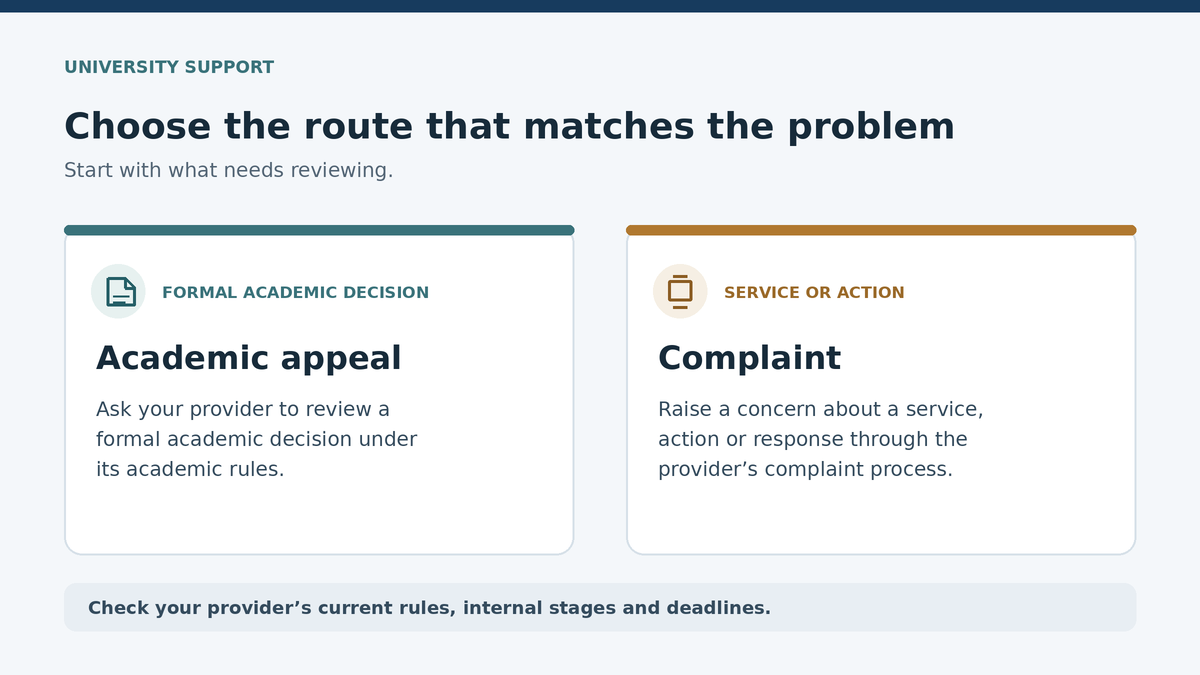
If you think a university decision or service has treated you unfairly, the first useful question is what kind of problem you have. An academic appeal usually asks the institution to review a formal academic decision under its rules. A complaint usually raises a concern about a service, action or experience. The routes can overlap, and the right one depends on the university’s regulations and the outcome you need. Labeling an issue incorrectly can delay it, so describe the facts and ask the relevant office which procedure applies.
What an academic appeal is for
An academic appeal challenges a decision made by an assessment board or another formal academic decision-maker, such as a progression, award or classification outcome. Common grounds may include a procedural error, relevant circumstances that the decision-maker did not know about, or evidence that the published rules were not followed. The institution’s regulations define the permitted grounds and evidence.
An appeal is generally not a second marking exercise. The Office of the Independent Adjudicator (OIA) explains that most providers’ appeal procedures do not let a student dispute academic judgment about the quality of work or the marking criteria themselves. If your concern is that a mark is wrong, check whether the university offers a mark-check or review process for administrative errors, and read the appeal rules before assuming that a different academic opinion is an appeal ground.
What a complaint is for
A complaint raises a concern about something the university did, failed to do, or how a service or person affected you. Examples could include a delay in providing an agreed adjustment, a problem with accommodation or administration, or concerns about how a course was delivered. The institution’s complaint policy sets out what it can investigate, how it handles evidence and which outcomes it can offer.
A complaint is not simply a more general appeal. A student may complain about a process or experience that affected an academic result, while an appeal asks for review of the academic decision itself. The OIA’s England and Wales guidance recognises that some issues do not fit neatly into one category and may need linked or separate processes. Ask the university to clarify how it will handle each part and whether one route must finish before another begins.
Choose by the decision or response you need
Start by writing one sentence describing the issue, then a second sentence naming the outcome you want. If you want a formal academic decision reconsidered under specified grounds, look at the appeal procedure. If you want the university to investigate service, conduct, communication or another experience, look at its complaint procedure. If both apply, say so rather than forcing the whole matter into one label.
For example, suppose a student says that an agreed adjustment was not available during assessment and they have received a progression decision. The provision of the adjustment may be a complaint about how support was delivered; asking the institution to reconsider the progression decision may require a separate academic appeal. This is an illustrative scenario, not a guarantee that either route will succeed. The student should explain the link and ask how the procedures interact.
If you are unsure, contact the students’ union advice service, student casework team or the office named in the regulations. Send a factual summary and ask which deadline applies while the route is being clarified. Do not wait for a meeting or informal discussion if a formal submission deadline may be running.
Compare the routes before submitting
| Question | Academic appeal | Complaint |
|---|---|---|
| What is being challenged? | A formal academic decision, such as progression or an award | A service, action, omission or experience |
| What rules control it? | Academic appeals or assessment regulations | Student complaints policy |
| What evidence may matter? | The decision, relevant regulation, procedure and supporting evidence for an allowed ground | A clear timeline, correspondence, records and explanation of the impact |
| What might the outcome do? | It may lead to review or reconsideration under the rules; it does not promise a higher mark | It may lead to an explanation, remedy or service improvement available under policy |
| Can they overlap? | Yes, where a complaint may have affected an academic decision | Yes; the university may coordinate routes or sequence them |
The table describes common distinctions, not a universal rulebook. Check the exact policy at your institution and course. Remedies and grounds differ, and neither process guarantees the result you request.
Prepare a clear record
Before submitting either route, collect the decision letter or case reference, the policy version that applies, relevant dates, and the correspondence or records connected to the issue. Make a short timeline in date order. Separate what you directly observed from what someone told you, and keep copies of documents in their original form.
For an appeal, identify the specific allowed ground and explain how the evidence relates to it. If you could not provide evidence earlier, explain why and check the policy’s rules about late evidence. For a complaint, describe what happened, when you raised the concern informally, what response you received and what practical outcome you are seeking. Keep the request proportionate and specific; asking for an investigation or a clear explanation is easier to assess than a broad demand that the university “make it right”.
- Check the deadline and submission method in the current policy.
- Use the required form and include the decision or service involved.
- Attach relevant evidence and label each file clearly.
- Keep a copy of your submission and proof that it was received.
- Ask about advice, representation, accessibility adjustments or support if you need them.
Do not send unnecessary sensitive information. If health information or personal circumstances matter, ask what evidence is relevant, who will see it and how to submit it securely.
Deadlines and internal stages matter
Universities set their own time limits and stages. An appeal may have a short window after an assessment or progression decision. A complaint may begin with local resolution and proceed to a formal stage if unresolved. Read the policy as soon as the issue arises, and note the date the clock starts, any required form and where the final internal response will be sent.
Informal discussion can sometimes resolve a misunderstanding quickly, but it does not necessarily pause a formal deadline. If you are pursuing informal resolution, ask in writing whether the submission deadline is extended. If the institution rejects a late submission or says your issue belongs in another route, ask for the decision and reasons in writing and check whether a review of that decision is available.
What happens after the university’s final response?
External review depends on where the provider is and which scheme covers it. In England and Wales, eligible students at OIA member providers can ask the OIA to review a complaint after completing the provider’s internal process and receiving a Completion of Procedures letter. The OIA’s scheme is independent, but it is not another university appeal and does not replace a court or tribunal route where one applies.
Scotland uses the Scottish Public Services Ombudsman (SPSO) after the institution’s internal complaints or academic appeals process, according to its student information. Northern Ireland has its own arrangements, so check the final response and current guidance for your provider rather than assuming the England and Wales route applies. External schemes have eligibility rules and time limits; follow the instructions in the institution’s final letter promptly.
A practical next step
Find your university’s current academic appeals and complaints policies, then match the issue to the decision or service you want reviewed. If the matter spans both, explain the connection and ask how the university will coordinate it. Get advice early, keep a dated record and submit through the official route before its deadline.
This article gives general study guidance, not a decision on an individual case. Procedures differ by institution and UK nation. The OIA’s guide to academic appeals and guide to complaints explain the England and Wales context; the SPSO provides student complaint guidance for Scotland. Research checked: 14 November 2026. Always verify the current policy and external route for your provider.
While you follow the formal process, review the student support services available at your university.