
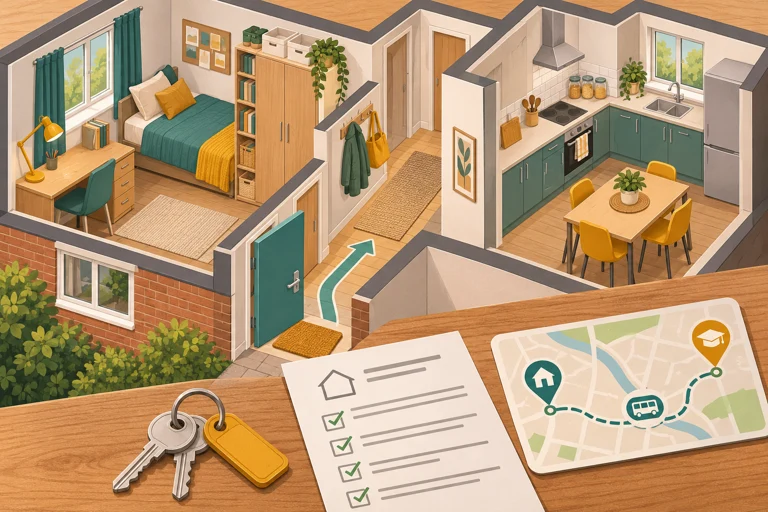
Choosing student accommodation is a decision about the whole study week, not just the room. Compare the full cost, journey to campus, contract dates, facilities and support you can actually use. University halls, private halls and a shared house can each suit different needs. Availability, prices and tenancy arrangements vary by place, provider and year, so verify the current details before paying or committing.
Start with your non-negotiables
Before viewing student accommodation listings, write down what your room and location must make possible. Think about the course timetable, your budget, health or accessibility needs, caring responsibilities, preferred household size and how often you expect to be on campus. Distinguish essentials from preferences. For example, step-free access may be essential; an ensuite bathroom may be a preference. This helps you compare realistic options without being distracted by photographs or a short-term promotion.
Check where teaching, placements, labs and libraries actually take place. A university may use more than one campus, and a course can involve travel to locations beyond the main site. Map the route at the times you expect to travel. Our commuter student guide explains how to check travel costs, route reliability and campus facilities. Consider a late class, an early placement start and the journey home after an evening activity, not only a midday trip on an open day.
Understand the main student accommodation options
| Option | What to check | May suit a student who… |
|---|---|---|
| University-managed halls | Room type, shared facilities, contract dates, bills, support and distance to teaching | Wants a university-managed setting and an established route to student support |
| Private halls | Provider, full price, included services, contract terms, support and travel | Wants purpose-built accommodation but is comparing providers outside the university |
| Shared private house or flat | Who is named on the agreement, household arrangements, bills, repairs and commute | Is comfortable sharing responsibilities and wants to choose a household or location |
| Living at home | Travel time, travel cost, timetable flexibility and a suitable study space | Has a workable commute and wants to remain in their current household |
This is a starting point, not a ranking. A private hall is not automatically more supportive than a shared house, and university ownership does not guarantee that every facility fits your needs. Ask who manages repairs, how to raise a concern and what happens if the room or service described is unavailable.
Compare student accommodation costs
Compare student accommodation costs over the same period. A weekly rent can look low if the contract runs for more weeks or if bills are separate; a higher weekly price may include services you would otherwise pay for. Make a simple total for each option using the dates you would occupy it.
- Rent for the full contract period, including weeks outside term if the agreement requires payment then.
- Utilities, internet, laundry, cleaning or other charges that are not included.
- Travel to teaching, placements, work and essential services.
- One-off costs such as bedding, kitchen equipment or moving belongings.
- Any deposit or advance payment, what it covers and the written terms for its return.
- Whether the accommodation requires a guarantor or another form of financial evidence.
Do not assume that “bills included” covers every service or that a quoted room rate includes optional fees. Ask for the full price and included services in writing. For an individual budget, put confirmed student finance and other support beside the actual payment dates. A room can fit the total annual budget but still create a cash-flow problem if rent is due before funding arrives.
Read the agreement before committing
Accommodation can involve different legal arrangements. In England, GOV.UK explains that a student renting from a private landlord may have a different tenancy type from a student in university or private halls. Rules can also differ across the UK and change over time. Read the agreement for the specific room and ask the university accommodation office or an appropriate housing adviser to explain anything you do not understand. A listing or conversation with an agent is not a substitute for the written terms.
Check the start and end dates, payment schedule, notice and cancellation terms, what happens if you withdraw from the course, and how a replacement tenant is handled. If you are sharing, find out whether each student has an individual agreement or whether the household has one agreement with shared responsibilities. Do not rely on a verbal promise about being released from a contract or changing rooms; ask for the relevant term in writing before signing.
For student accommodation linked to a university offer, check whether the room is guaranteed, what conditions apply and when an offer can be withdrawn. For a private provider, verify that you are communicating with the actual provider or an authorised agent. Do not send money or identity documents until you have checked the room, provider and payment instructions through a trusted route.
Test the day-to-day fit
When viewing student accommodation, look beyond the room itself. Ask how noise, shared kitchens, visitors, quiet hours, security, parcel delivery, internet access and repairs are managed. If you will study at home, check whether there is a desk, a reliable connection and a place where you can concentrate. If you have an early placement, consider whether the route works at that time and whether transport is available on the days you need it.
Students with disability, long-term health or access needs should contact the university’s disability or accommodation team early. Describe the practical features you need rather than relying on labels such as “accessible”. Ask about the route into the building, lifts, bathroom layout, alarms, distance to teaching and how adjustments are arranged. Confirm any agreed provision in writing and check what happens if a room must change.
A hypothetical comparison
Imagine two rooms are both advertised as close to campus. Room A has a lower weekly rent but a longer contract and bills charged separately. Room B costs more each week but includes internet and utilities for a shorter period. A student should calculate each option across the actual dates, add likely travel and ask what “utilities included” means. If the course uses another campus for labs, the shorter map distance may not describe the real commute. These are hypothetical details; the exercise shows how to compare terms rather than suggesting typical prices.
Use a decision framework
Give each option a short rating against the same five questions: Can I afford the full arrangement? Does the commute work for my timetable? Does the room meet my access and study needs? Do I understand the contract? Is the management and support route clear? Mark any unknown as a question to resolve, not as a positive assumption. If an option fails an essential requirement, remove it from the shortlist or find out whether that requirement can be met before deciding.
There may not be one perfect option. Someone who values independence may accept more household responsibility; someone who prioritises predictable services may prefer managed accommodation. The useful choice is the one whose confirmed terms fit your priorities, finances and study pattern. Ask a trusted adviser to review the comparison if you are unsure, especially before signing a contract you cannot easily change.
Before you pay
- Confirm the address, room type, provider and move-in date.
- Read the complete agreement and save a copy.
- Get the total price, included services and payment dates in writing.
- Check how to report repairs, safety concerns or a dispute.
- Verify payment details with the provider using a contact route you already trust.
- Keep receipts and communications in one place.
For student-tenancy information in England, see the current GOV.UK guide to renting as a university student. For other nations or an individual agreement, check the relevant current housing guidance and ask your university or a qualified housing adviser. Accommodation terms and legal protections depend on the arrangement and location.