
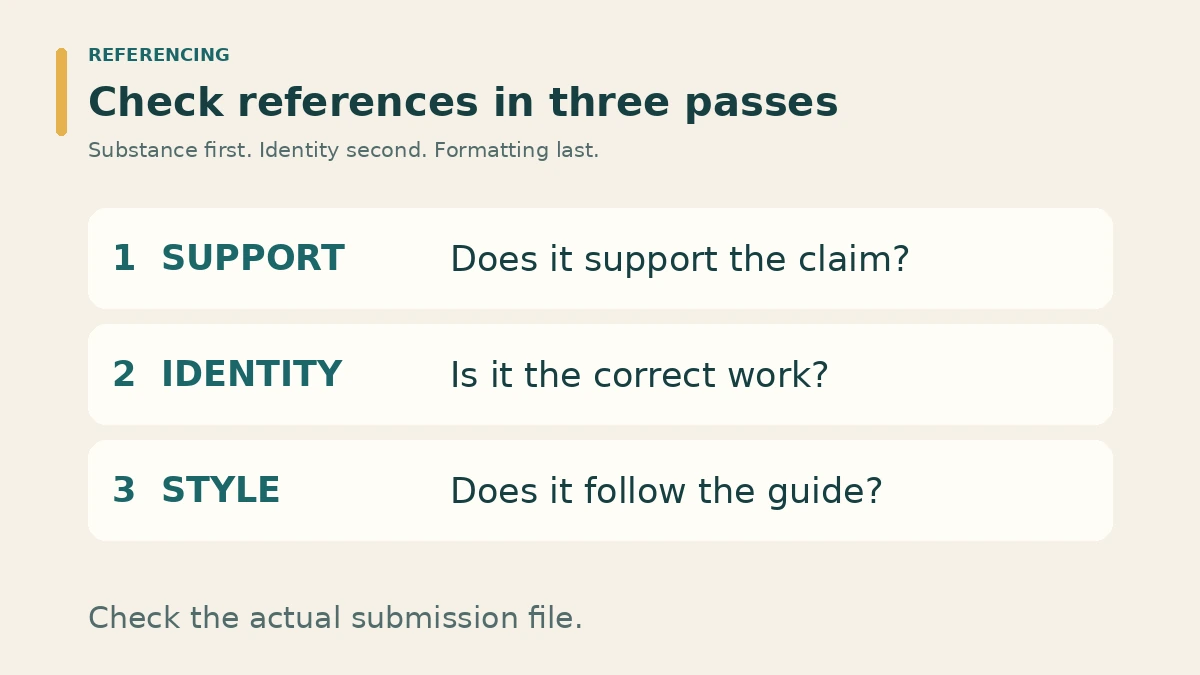
Check your citations in three separate passes: first confirm what each citation supports, then match it to the correct source record, and finally apply the required referencing style. This order helps you notice errors that a punctuation-only check would miss, including a citation attached to the wrong claim or an entry describing the wrong edition.
Keep the assignment, the sources you used and your institution’s referencing guide open together. The method below is an optional final audit for ordinary coursework. It does not replace subject-specific requirements, and it does not mean that every assignment requires the same kind of reference list or bibliography.
Confirm the rules for this assignment
Find the named referencing system in the module instructions. Check whether there is a local guide or a specified edition. A broad label such as “Harvard” does not settle every formatting detail, so use the version your department requires rather than combining examples from unrelated websites.
Identify the required end matter. A reference list normally identifies cited material, while a bibliography may have a wider scope under the relevant system. Follow the assignment’s definitions and examples. Do not remove uncited background reading from a required bibliography simply because another course uses a reference list.
Also check how the system handles quotations, page locators, different works by the same author and unusual source types. You do not need to memorise every rule before beginning the audit. Keep the official guidance available and consult the relevant example when a particular issue arises.
The University of Exeter’s referencing checklist recommends checking references before submission whether they were entered manually or produced with reference-management software. Automation can organise your work, but the final document still needs inspection.
Save a recoverable copy before substantial changes. If a reference manager is involved, keep a working version with its citation links intact. Follow that tool’s current help guidance for any final conversion or export required by your institution; do not experiment on your only copy.
Pass one: inspect the claim beside each citation
Read a paragraph as an argument before looking at the reference list. Identify which statements depend on external material and whether the citation makes that relationship clear. A reference placed at the paragraph’s end may leave uncertainty about which of several statements it supports.
Open the source and locate the relevant passage. Confirm that your wording preserves its meaning and limitations. A citation is not a substitute for support: a genuine publication can still be attached to a claim that it does not establish.
Separate exact wording from your own explanation. Check that quotations are marked and located as required, and that paraphrases acknowledge the source. If copied wording has been mistaken for a paraphrase, repair the writing and attribution before tidying the citation’s punctuation.
Do not cite material as though you read it directly when you only encountered it through another author. Try to obtain the original through legitimate routes if it is important. If you cannot, follow your institution’s guidance for secondary citation and make the relationship transparent.
The University of Worcester’s referencing advice asks students to check that cited material has been read, references are genuine and traceable, and entries correspond with the assignment. Those checks concern the substance of referencing as well as its appearance.
Pass two: connect each citation to the right record
Work through the document and mark the matching record for every citation, using the procedure appropriate to your system. Then work backwards from the end matter to the text. Keep any legitimate exceptions visible rather than forcing every source type into the same pattern.
Check the identity of the work. Compare the author, title, year, edition or version and publication details with the actual source. For a chapter in an edited book, distinguish the chapter author from the editor. For an institutional document, check the credited organisation rather than guessing from a website footer.
Look for records that seem similar but describe different things. An online-first article and its later published version may have different details. A book review is not the book it reviews. A repository record may describe a manuscript rather than the final journal version.
Check identifiers and links where relevant, but do not treat a working link as proof that all details are correct. It may open a publisher’s page for a related edition or a different article. The record must identify the material you actually used.
If a source cannot be traced, investigate the gap while there is time. Search your saved files and legitimate catalogue records using the details you have. Do not invent a missing year, page range or author to make the entry look complete. Use the referencing guide’s approach to genuinely absent information.
A short mismatch exercise
Suppose a fictional draft cites “Source A” when discussing a definition, but the end matter contains two records with similar titles. One describes a chapter and the other describes a review of the book containing that chapter. These labels are exercise placeholders, not real references.
The right repair begins with the text you actually read. Open it and identify the document type, author and publication details. Locate the definition and confirm that the sentence represents it correctly. Only then decide which record belongs in the final document.
Now suppose “Source B” appears in the list but nowhere in the assignment. Check whether its citation was accidentally deleted during revision or whether the supporting paragraph was deliberately removed. The appropriate action depends on that history and on whether the required end matter is a reference list or a wider bibliography.
Finally, imagine that a cited webpage has a newer update than the saved version used during drafting. Do not silently combine the old wording with new bibliographic details. Inspect whether the relevant content changed and decide which version supports your final sentence.
The exercise shows why a two-way match needs interpretation. A mechanical check can flag an unmatched record, but it cannot decide whether the argument needs restoration, the entry should be removed or the source relationship must be explained differently.
Pass three: make the style consistent
Once identity and support are sound, compare formatting with the required guide. Check the appropriate author presentation, date placement, title treatment, publication details and ordering rules. Focus on the examples relevant to the source types you actually use.
Do not apply alphabetical ordering automatically if your system organises references by citation sequence. Similarly, do not add access dates or page numbers indiscriminately. The correct treatment depends on the system and the material.
If you use a reference manager, repair incorrect source data in its record where appropriate, then refresh the document using the supported process. A manual edit to generated text may disappear when the bibliography updates. Preserve your working copy and inspect the result after the refresh.
Check a few representative source types against the guide before making a large global change. A journal article, chapter and website can require different fields. Repeating one attractive template across all entries may create consistent-looking errors.
Inspect the actual submission file
Open the final file in the format you will submit. Confirm that citations, footnotes and end matter are present and readable. If you exported a PDF, inspect that export rather than assuming that everything visible in the working document transferred correctly.
Remove private research notes and unresolved placeholders from the reader-facing version. If an important source issue remains, resolve it through the appropriate academic support channel rather than disguising it with plausible details.
Finish with a small unresolved-issues check: which claims still lack support, which records remain uncertain and which local rule needs clarification? Referencing is ready when readers can understand where the material comes from and find the sources, with the required conventions applied to the final work.
Related reading: How to Decide Whether a Source Supports Your Assignment Claim; Academic Integrity at University: How to Use Sources and Work Independently.