
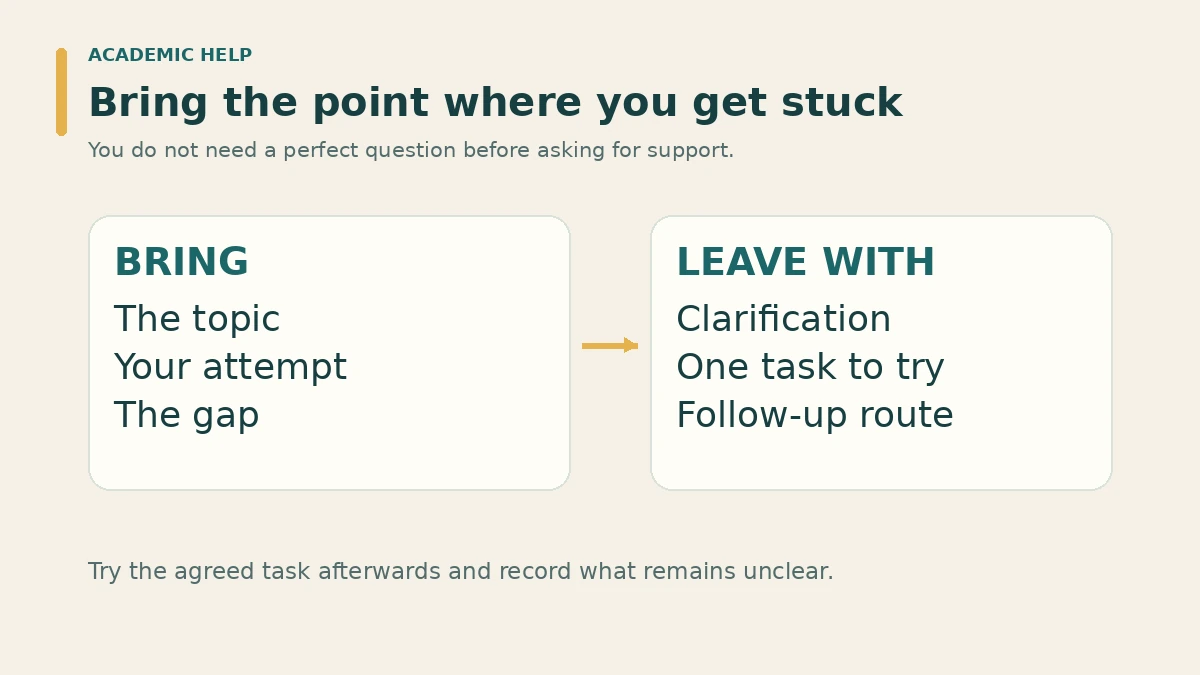
To ask a tutor for academic help, describe the part of the course you are working on, show where your understanding stops and explain what you have already tried. You do not need a polished question before seeking support. A specific starting point simply makes it easier to use the conversation well.
After the meeting, turn the explanation into one task you can attempt independently. The aim is to leave with a clearer route through the difficulty, rather than a promise that the tutor will approve your answer or complete the work for you.
Start with a small account of the difficulty
Write what you are trying to understand in ordinary language. You might be able to follow a definition but not apply it, reproduce a worked example but not choose the method, or understand two explanations separately but not distinguish them. These are different difficulties.
Find the nearest concrete location: a reading passage, lecture slide, tutorial question or stage in your working. Keep it available. A tutor cannot always diagnose “I do not understand the module” immediately, but one example can reveal where the broader difficulty begins.
Record what you tried and what happened. Perhaps rereading clarified the vocabulary without resolving the argument, or a practice problem exposed a missing assumption. This is information about the problem, not a test you must pass to deserve help.
If you cannot identify any particular point, say that. Explain which part of the course you have been attempting and ask for help deciding where to start. Preparation should support access to help, not become another barrier when you are already uncertain.
Find the appropriate route
Check the module page or handbook for teaching contacts, appointment arrangements and question channels. Some issues belong with the class tutor, others with a module lead, academic adviser or professional support team. Do not assume that every university uses the same names or booking process.
The LSE academic-support guidance distinguishes course questions from wider advising and specialist support. It also recognises that students may need to reach out before they can describe a difficulty precisely. Apply those broad principles while checking the arrangements at your own institution.
For an assessment question, inspect the stated limits on draft feedback and discussion. You can ask for clarification without expecting staff to certify a complete answer in advance. If the permitted scope is unclear, ask what kind of support can be provided.
Check whether an appointment is in person, online, booked or a drop-in. Confirm any materials the tutor requests. If you cannot attend, use the cancellation or rearrangement route provided. Avoid inferring a general university rule from a booking system used by another department.
Write a request that can be understood quickly
Use your university email account where appropriate and give the message a meaningful subject. Include the module or class identifier when it helps the recipient place the question. Address the tutor using their stated name or title rather than guessing.
The University of Southampton’s email guidance recommends clear, polite, concise messages, relevant subject lines and checking readily available course information first. These are practical communication principles, not a guarantee of a particular response time.
A useful message states the topic, the difficulty and the request. For example, in a fictional module about interpreting diagrams, a student might explain that they can label the components but cannot explain why changing one component affects another. They could request a discussion of that relationship at the next available appointment.
Keep the supporting material proportionate. Identify a page or attach the particular permitted example rather than sending an entire unorganised folder. Check that the file opens and that it does not contain unrelated private information or someone else’s assessed work.
If a deadline matters, state its actual date without implying that staff must answer immediately. Follow published response expectations and the institution’s route for urgent administrative problems. Sending the same question repeatedly through several channels can make the conversation harder to track.
Build a short agenda
Choose the question that most affects your next learning task. If you have several questions, put them in a sensible order and recognise that one appointment may not cover everything. The tutor can help decide which issue should come first.
An optional question ladder is: “What does this mean?”, “Why does this step follow?” and “How would I recognise when to use it?” You do not need all three every time. Use the rung that matches the difficulty rather than asking for a general explanation of material you already understand.
Bring your attempted explanation as well as the source. A tutor can respond more precisely when they can see the connection you have made. Label uncertain parts clearly so that an unfinished idea is not mistaken for your settled view.
Leave space to record the answer and the next task. Notes can be brief, but distinguish the tutor’s explanation from your own proposed application. Check local arrangements before recording a meeting or uploading its contents to an external service.
Use the meeting to test understanding
Begin by identifying the agreed topic and showing the relevant example. Explain where you can follow the reasoning and where it breaks down. If the tutor’s first explanation does not resolve the issue, describe the remaining uncertainty rather than agreeing simply to keep the conversation moving.
Try explaining the point back in your own words. This gives both of you something to inspect. You might discover that the definition is now clear but its relationship to the example remains uncertain. That is useful progress because the next question is narrower.
In the fictional diagram example, the student initially assumes that two connected arrows always mean the same kind of relationship. During discussion, they discover that one indicates a sequence and another indicates a dependency. Their next task is to inspect how the diagram’s key distinguishes those meanings.
The tutor need not provide a finished explanation for every diagram. The student can try a second permitted example, identify the kind of relationship and justify the interpretation. This changes the meeting from passive receipt of an answer into a chance to examine the method.
The scenario is invented and makes no claim about a real course or learning outcome. The point is to make your reasoning visible so that misunderstandings can be discussed at the level where they occur.
Leave with a task you can attempt
Before finishing, confirm what you will do next and which material to use. A workable next action could be to annotate one example, compare two definitions or attempt a related tutorial problem. “Understand the topic better” does not tell you what to open after the appointment.
Ask how to follow up if the same difficulty remains. The appropriate route may be another class question, a later appointment or an academic-skills resource. Do not assume that the tutor will provide unlimited individual draft checking.
Afterwards, attempt the agreed task before polishing the meeting notes. Record what you can now explain and any remaining gap. If you return for help, bring that attempt so the conversation can build on what changed.
Finally, avoid turning contextual advice into an absolute rule. An explanation about one question may depend on its particular assumptions. Keep the source, example and boundary beside the advice, then check whether those conditions apply when you use it elsewhere.
For help beyond an individual tutor meeting, review university student support services.