
Rehearse an academic presentation aloud with the materials you will actually use. Time the whole talk, note where the explanation becomes difficult to follow and revise the content before rehearsing again. If you run over, remove or simplify material according to its purpose rather than trying to say everything faster.
Slides alone cannot tell you how long an explanation takes. The Open University’s presentation guidance emphasises purpose, audience, a clear message and rehearsal to check timing. The process below turns those general principles into an optional editing exercise. Your assessment brief remains the authority on duration, required content and delivery arrangements.
Establish the boundary before starting the timer
Confirm the speaking time and whether it includes questions, a demonstration or changing speakers. Check any instructions about recorded delivery, notes, slide submission and referencing. If the timing rule is unclear, ask before building a plan around an assumed allowance.
Write the audience’s starting point and the main thing they should understand by the end. A presentation to classmates who know the module can begin differently from one for an audience unfamiliar with its terminology. Avoid spending precious time explaining everything you know about the broader subject.
Next, write a sentence describing the talk’s central argument or explanation. Under it, identify the material needed to make that point understandable and credible. Everything else must justify its place: does it establish context, support the reasoning, qualify the conclusion or help the audience follow?
This is a planning test, not a rule that presentations can contain only one idea. A complex argument may need several stages. The question is whether listeners can see why each stage is there, rather than encountering a sequence of facts whose relationship remains implicit.
Check accessibility and delivery arrangements early. If you need particular equipment or adjustments, discuss the relevant process with your institution. Do not use a general rehearsal schedule as a reason to disregard agreed arrangements or assume that everyone should deliver in the same way.
Run one rehearsal without stopping to polish
Use your slides, notes or other materials in their intended order. Speak the explanation rather than silently reading it. If you make a minor mistake, mark it and continue. Repeatedly restarting the introduction can produce a familiar opening and an unrehearsed ending.
Record the start and end of the main sections. You can use a timer and a simple note sheet. A recording may also help if you are comfortable making one and the material permits it; keep it private unless everyone involved has agreed to sharing.
Afterwards, separate three questions. Did the content answer the task? Could a listener follow the explanation? Did it fit the time? A presentation can fail one of these while succeeding at the others. Treating every difficulty as a speaking-speed problem leads to unhelpful editing.
For example, a long pause might occur because you cannot find your next note. That suggests a navigation repair. A long explanation of an unfamiliar term might reveal missing audience preparation. Removing the term’s definition could shorten the talk while making the reasoning less understandable.
If someone listens to the rehearsal, give them a focused task. Ask them to record where they lost the thread, which claim needed more support or what conclusion they understood. “Was it good?” invites a broad impression when you need evidence for a particular revision.
Do not interpret a supportive listener’s reaction as a prediction of your assessment mark. Their feedback can identify communication problems, while the tutor’s criteria determine what the assessed presentation requires.
Use a timing budget to expose the trade-offs
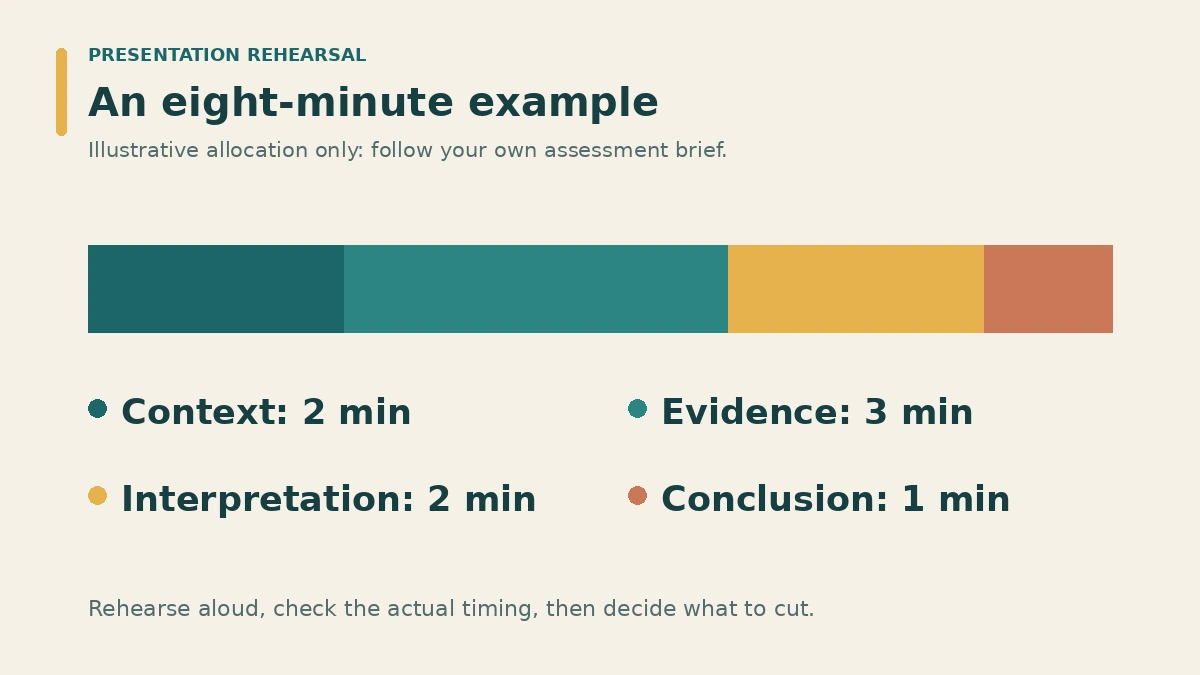
Suppose a fictional assignment allows an eight-minute talk, with questions handled separately. A student plans two minutes for context, three for evidence, two for interpretation and one for the conclusion. The arithmetic is eight minutes in total; it leaves no additional allowance for unplanned material.
In rehearsal, the talk takes ten minutes. The student needs to remove or simplify two minutes to meet the hypothetical limit. Speaking every sentence faster would not explain which parts are unnecessary and might make important reasoning harder to follow.
They inspect the context section and discover that half of it repeats material the intended audience already knows. They also find two examples making the same point. They choose one example and replace a lengthy transition with a direct explanation of how the evidence connects to the interpretation.
The next rehearsal must test the changed version. It is not enough to estimate that the cuts “should save about two minutes”. Explanations can change when spoken, and moving material may create a new need for context elsewhere.
These timings are an invented planning example, not a recommended allocation for every presentation. Some tasks need a substantial methods section or a demonstration. Build your own budget around the assessed purpose and preserve time for the content that makes the answer defensible.
If a technical demonstration has uncertain timing, discuss the expected format with the tutor and test the permitted setup. Do not assume that a successful rehearsal on your own device establishes how the assessment room or recording service will behave.
Cut by function, then repair the connection
Start with repetition. If two slides establish the same point, decide whether both add something necessary. Keep the clearer example, or explain the difference between the examples if that difference is part of the argument. Do not retain duplication simply because both slides took time to make.
Next, examine background detail. Include what listeners need to understand the question and evaluate the answer. A historical aside may be interesting but unnecessary for this particular task. Keep additional reading in your preparation notes rather than forcing it into the spoken presentation.
Protect the evidence supporting the central claim. If you remove the explanation that makes a conclusion justified, the shorter version may become less credible. Sometimes the right cut is to narrow the conclusion so that the evidence you can explain properly is sufficient.
Also protect important qualifications. Replace a long, repetitive account with a concise limitation where possible, but do not turn an uncertain result into an absolute claim for the sake of a tidy ending. An honest boundary can be a necessary part of the answer.
After each cut, inspect the surrounding transition. Listeners cannot see the deleted section, so the next sentence must still make sense. A slide titled “The second problem” needs revision if the first problem has disappeared from the final version.
Keep a recoverable copy of the earlier draft. This makes it easier to restore a useful explanation if the edited version creates confusion. Avoid maintaining several files with indistinguishable names; identify which version is the current rehearsal version.
Rehearse the revised version as a complete talk
On the next pass, test the whole sequence again. Check that the opening establishes the question, the evidence supports the explanation and the ending states the resulting judgement. Use the timer to confirm the actual duration rather than relying on how much shorter the slides look.
Check your notes at the moments that previously caused difficulty. A short cue such as “explain why these cases differ” may work better than a crowded paragraph you cannot scan while speaking. Alternatively, a carefully written sentence may help with a precise transition. Choose what works for the task.
Practise moving between materials as well as delivering individual sentences. If you switch from slides to a document, include that action in the rehearsal. A polished explanation of each item can still become disjointed when the movement between them has not been tested.
Prepare for questions by identifying the claim most likely to need clarification and the limits of your evidence. Do not invent an answer to cover a gap. You can distinguish what your material supports from what would require further investigation.
Finally, keep a brief note of the last rehearsal’s timing and remaining issues. Prioritise changes that affect the answer, clarity or confirmed requirements. Rehearsal should leave you with a presentation you can deliver and explain, rather than an endless collection of increasingly decorative slides.
Related reading: How to Prepare for a University Seminar and Make a Useful Contribution; How to Ask a Tutor for Academic Help and Use the Meeting.