
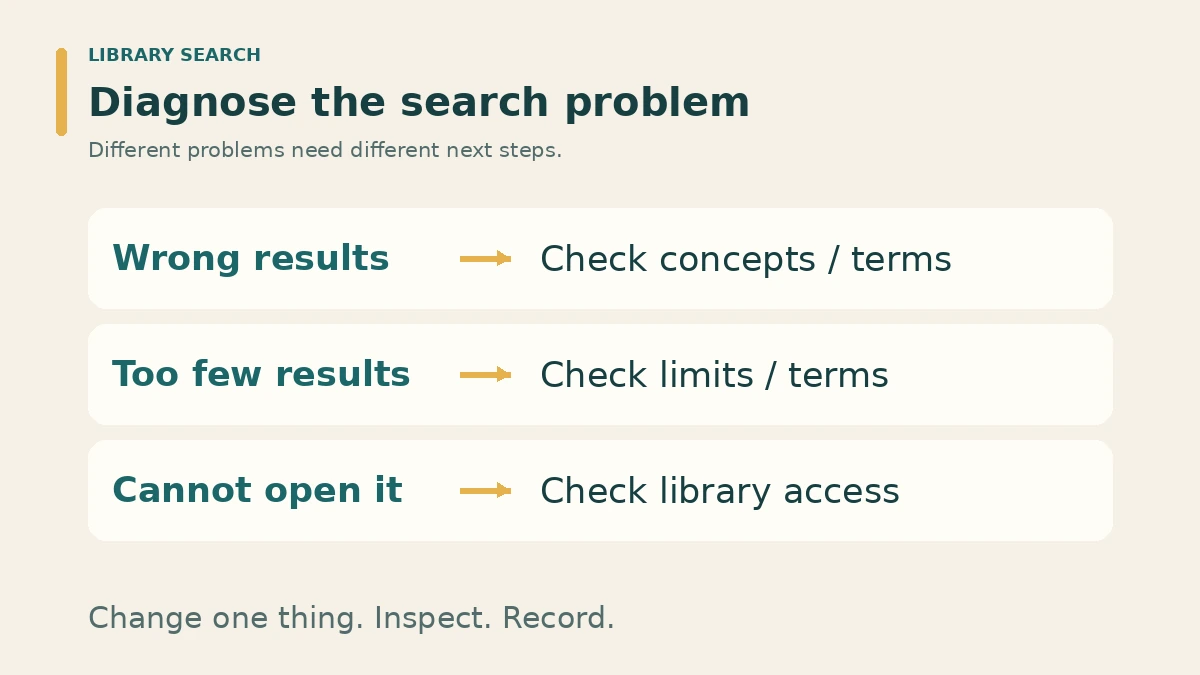
When a library search produces the wrong results, change one part of the search deliberately and inspect what changes. First decide whether the problem is irrelevant results, too little relevant material or difficulty accessing an item you have already found. These problems need different repairs.
Do not simply repeat the assignment title with small spelling changes. Build a short record of the concepts, terms and settings you used. The method below is an optional workflow for ordinary university assignments. It is not a systematic-review protocol or a guarantee that every relevant publication will be found.
Identify which problem you actually have
Open a few results and compare them with your research question. If they concern another meaning of the same word, the issue may be an ambiguous term. If they concern the right subject but a different setting, your context may need clearer expression.
If there are very few results, inspect the search before concluding that no literature exists. You may have combined too many requirements, selected a restrictive field or applied a filter unintentionally. An exact phrase copied from your assignment might not be the terminology authors use.
If the results look relevant but full text is unavailable, stop changing subject terms. You have an access question. Use the library’s legitimate access routes or ask library staff about options, rather than treating an unavailable download button as evidence of an unsuccessful subject search.
Write the problem in one sentence. For example, “Results discuss building design, but I need studies about students choosing study locations.” That diagnosis gives the next search a purpose and makes it easier to judge whether a change helped.
Separate concepts from the sentence in the brief
Underline the central ideas in your question and make a small concept list. Leave out instruction words such as “discuss” or “evaluate” unless they are themselves part of the topic. Search tools usually need subject terms rather than the complete wording of an assessment task.
For each concept, list plausible alternative terms. Distinguish a synonym from a broader or narrower idea. “Library” and “study space” may overlap in your project, but they are not interchangeable in every context. Record that difference instead of treating every related term as equivalent.
The Open University’s search guidance recommends gathering relevant keywords, using search techniques appropriate to the resource and checking its help instructions. It also suggests keeping a search record. Those principles support a deliberate approach rather than repeated guessing.
Use relevant sources you have already found to investigate terminology. Look at their titles, abstracts and subject terms. You are learning how the topic is described, not copying the authors’ conclusions into your assignment. Keep potentially useful terms separate from claims that still need evaluation.
Check the tool and its settings
Confirm which service you are searching: the library catalogue, a broad discovery tool or a subject database. Read the library’s description of its coverage. If your topic requires material outside that coverage, changing keywords indefinitely may not solve the problem.
Inspect active limits, including date ranges, language, source type and search field. A title-only search can behave differently from a broader keyword search. Record the settings that matter so you can reproduce the attempt or explain it to a librarian.
Check syntax in that tool’s own help page. Phrase searching, truncation and operators are not implemented identically everywhere. Avoid moving a complicated search string between services and assuming that punctuation or field codes will retain the same meaning.
You do not need an advanced technique merely because it is available. Start with a manageable search that exposes the vocabulary and likely material. Add complexity when it solves an identified problem, and keep enough of the earlier version to see what the change did.
Use combinations deliberately
In many academic search tools, AND connects concepts that must be represented and OR groups alternatives. Check the local syntax before relying on either. Parentheses can help show which alternatives belong together when the service supports them.
For an illustrative search about commuting and university attendance, you might investigate a group of commuting terms alongside a group of higher-education terms. Decide separately whether attendance belongs in the first search or would exclude useful material discussed in broader studies.
The UCL search-strategy checklist advises checking whether concepts are too narrow or broad and whether operators are used correctly. It cautions about unintended exclusions from NOT. Treat exclusion as a decision requiring inspection, rather than a quick way to make a result list look cleaner.
These are search principles, not a ready-made string for every database. Your service may offer separate search rows or subject headings that make the intention clearer. Ask library staff for help translating the concept plan into an appropriate search for the resource you are using.
A fictional repair sequence
Imagine a student researching how students select quiet places to read on campus. Their first search uses only “reading”. The sample results they inspect include literacy teaching and interpretations of literary texts. Those topics may be valuable, but they do not answer the current question.
The student adds a concept for study locations. Before adding a long list of restrictions, they inspect the next sample. They notice that useful papers describe “study spaces”, so they record that phrase as a candidate term rather than insisting on the original wording.
Next, they try adding a term for university students. If relevant material disappears, they compare the changed search with the previous version. Some papers may describe their participants in the abstract without using the exact population phrase in the title. The selected search field now deserves attention.
Finally, they discover that a relevant item is described in the catalogue but its link does not open. They save the bibliographic details and ask the library about access. They do not rebuild the topic search to solve what is now a different problem.
This sequence is fictional and reports no actual search counts or research findings. It illustrates how each change can answer a diagnostic question. Real searches should be judged from the actual records retrieved, their coverage and the assignment’s needs.
Keep a small change log
For each useful attempt, record the service, date, terms, important settings and what you learned. A short observation such as “This term retrieves the intended setting but mostly staff experiences” can be more informative than recording a large result count alone.
Change one meaningful element at a time where practical. If you alter the terms, date range and source type together, you may not know why the results changed. A controlled comparison makes it easier to keep a successful adjustment and reverse an unhelpful one.
Preserve promising records with their full details. A browser’s back button is not a reliable research log. Use your library’s saving tools or your own source record, and verify exported details before using them in a reference list.
Decide when to ask for help or move on
Ask a librarian when repeated deliberate changes still miss the topic, when database coverage is unclear or when technical access problems persist. Bring your question and a few search attempts. That gives the discussion a concrete starting point.
A more relevant result list is only the beginning. Open the sources and evaluate whether their evidence supports your argument. Finding a matching title does not establish quality, and a large collection of records does not establish that your assignment question has been answered.
Before ending the session, identify the next task: read a promising source, test a missing concept or resolve access. Stop collecting near-identical searches once you have enough material for that next step. Return to searching when your reading reveals a specific gap.
Related reading: How to Decide Whether a Source Supports Your Assignment Claim; University Dissertation Planning: From Topic to a Manageable Question.