
Before dividing a university group project, agree what the finished work must achieve, how the parts connect and how the group will make decisions. Then assign tasks with clear outputs and handover dates. Dividing pages equally is not enough if nobody has checked how those pages will become one coherent submission.
A short working agreement can make these expectations visible. It need not be a complicated contract. The method below is an optional organising approach, with a fictional example. Follow your module’s rules on collaboration, assessment, contribution records and submission wherever they differ from general advice.
Read the assessment instructions together. Identify the group output, individual components and any required process evidence. Some projects involve a shared presentation plus a personal reflection; others assess one collective product. Do not assume that permission to collaborate applies equally to every part.
Record the unresolved questions and send them through the appropriate module channel. Ask about the specific uncertainty, such as whether members can share drafts of an individual reflection. Meanwhile, continue work that clearly falls within the authorised group task.
The University of Edinburgh’s group-working guidance recommends agreeing communication, meetings, deadlines and responsibilities, then recording the arrangement. That provides a useful foundation. This guide develops a particular way to specify handovers and connect work between members.
Identify the final submission process early. Confirm the required format, location and deadline from the official instructions. If one person will upload the work, arrange how everyone will review the final version and how the group will check that the submission has been received.
Describe the finished output before assigning sections
Write a short shared description of what the project should enable its audience to understand or do. Keep it connected to the assessment task. A report explaining a problem, a proposed solution and its limitations needs a different structure from a collection of unrelated topic summaries.
Sketch the main parts and the relationships between them. Ask what information each part needs from another. A recommendation may depend on findings from the analysis, while a presentation’s introduction may depend on the final conclusion. Notice these connections before assigning independent deadlines.
Agree a few common decisions: key terms, scope, audience and the evidence needed for major claims. This does not mean everyone must think alike. It gives disagreements a shared starting point and makes incompatible assumptions easier to spot while there is time to resolve them.
Avoid finalising every detail in the first meeting. Some decisions require research. Mark those as provisional and identify when they will be revisited. A working agreement should distinguish an agreed requirement from a temporary assumption, rather than making both look equally settled.
Give each task a usable handover
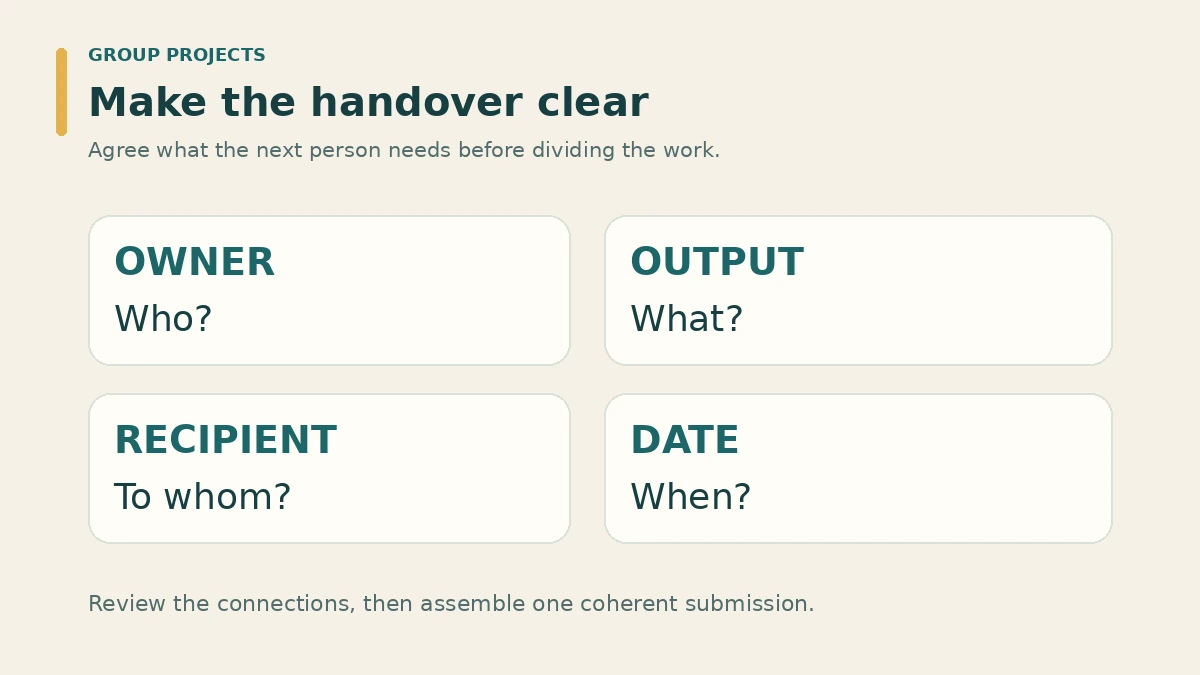
For each task, record the owner, the expected output, its recipient and the handover date. Add what the recipient needs to use it. “Research section two” is vague; “Provide a comparison of the two options, with source locations and unresolved limitations” describes an inspectable contribution.
Name the next dependency. If the recommendations cannot be drafted until the comparison exists, make that relationship explicit. The first task’s internal deadline should leave time for the second task and for integration, rather than placing both on the final evening.
Agree what counts as ready for review. A rough draft can be useful if it contains the necessary reasoning and identifies its gaps. A polished document with no sources may be unusable. Set expectations around function and evidence before spending time matching fonts.
Keep workload discussions open. Equal numbers of tasks do not necessarily mean equal effort. If one person has a technically demanding task or a substantial integration role, consider that when allocating the rest. Review the arrangement when the real work becomes clearer.
A fictional exhibition project
Imagine four students planning a fictional assessed exhibition about local reading spaces. They initially propose that each member write one display panel. That seems tidy, but the panels could repeat background material and leave the exhibition without a clear route for visitors.
Instead, the group agrees that visitors should understand how different spaces serve different reading activities. They identify three comparisons and a final display explaining the limits of their observations. The project now has a shared question and a reason for each part.
One member prepares the observation framework, another locates background sources and two test the framework on invented sample descriptions before any real project activity begins. The group notices that “quiet” means different things in their drafts and agrees an explicit working definition.
Their handover note specifies that each panel needs a main point, supporting material and a link to the next panel. The member assembling the display can now check consistency without inventing the argument for everyone else. Members remain responsible for reviewing the assembled version.
This example describes a planning exercise, not a real exhibition or research project. Any actual data collection must follow the module’s instructions and relevant institutional processes. The transferable lesson is to resolve shared definitions and connections before treating separate contributions as finished.
Choose a communication process people can follow
Agree where decisions will be recorded and where working files belong. A chat can be useful for quick questions, but important decisions should not depend on someone scrolling through hundreds of messages. Keep one accessible record of the current plan.
Discuss practical availability without requiring members to disclose personal details. Agree realistic response expectations and meeting options. Silence over a weekend should not automatically be interpreted as refusal to contribute if the group never agreed that weekend replies were expected.
End meetings with decisions, owners and dates. If a question remains unresolved, record who will investigate it and when the group will decide. A meeting that produces many ideas but no next action can leave members with incompatible understandings of what happens afterwards.
Make space for members who communicate differently. Circulating a short agenda and allowing written comments can offer another route into the discussion. Ask what arrangements would help the group work effectively, and use institutional support where specific access arrangements are needed.
Deal with changes while they are still manageable
When a task changes, update the people who depend on it. Explain what changed, why and which dates or outputs are affected. Quietly replacing an agreed approach can invalidate someone else’s work even if the replacement looks better in isolation.
If a member misses a handover, first establish what is actually unfinished and what support or adjustment is possible. Discuss the task rather than guessing at motives. Agree a revised action and record it so that the next review has a concrete reference point.
For persistent difficulties, consult the module’s process and approach the tutor with factual records. Do not invent penalties, remove names or redistribute assessed responsibilities contrary to the rules. The teaching team can explain the options available for that particular assessment.
Integrate and review together
Allow a separate stage for integration. Check whether the sections answer the shared question, use terms consistently and support the final judgement. Integration is intellectual work as well as editing; joining files does not necessarily join the reasoning.
Give every member a clear opportunity to review the final product. Identify which changes require group agreement and which are routine corrections. Preserve a recoverable version before substantial edits, especially when several people can change the same document.
Before submission, compare the final work with the official requirements and the group’s agreed output. Confirm who will submit and how the receipt will be checked. Afterwards, keep the contribution records required by your module and note one practical change that would improve the next collaboration.
Related reading: University Group Project Problems: When Contributions Are Uneven; How to Rehearse an Academic Presentation and Decide What to Cut.